Home / Types / Dobsonian / Newtonian
Dobsonian and Newtonian telescopes
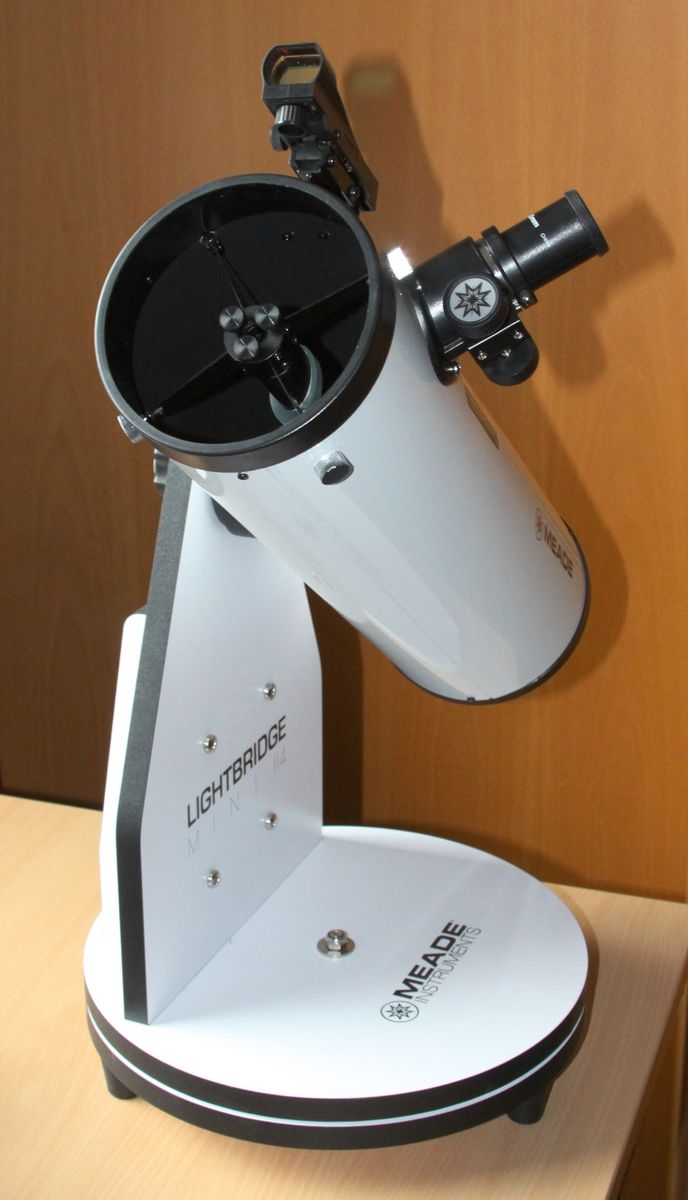
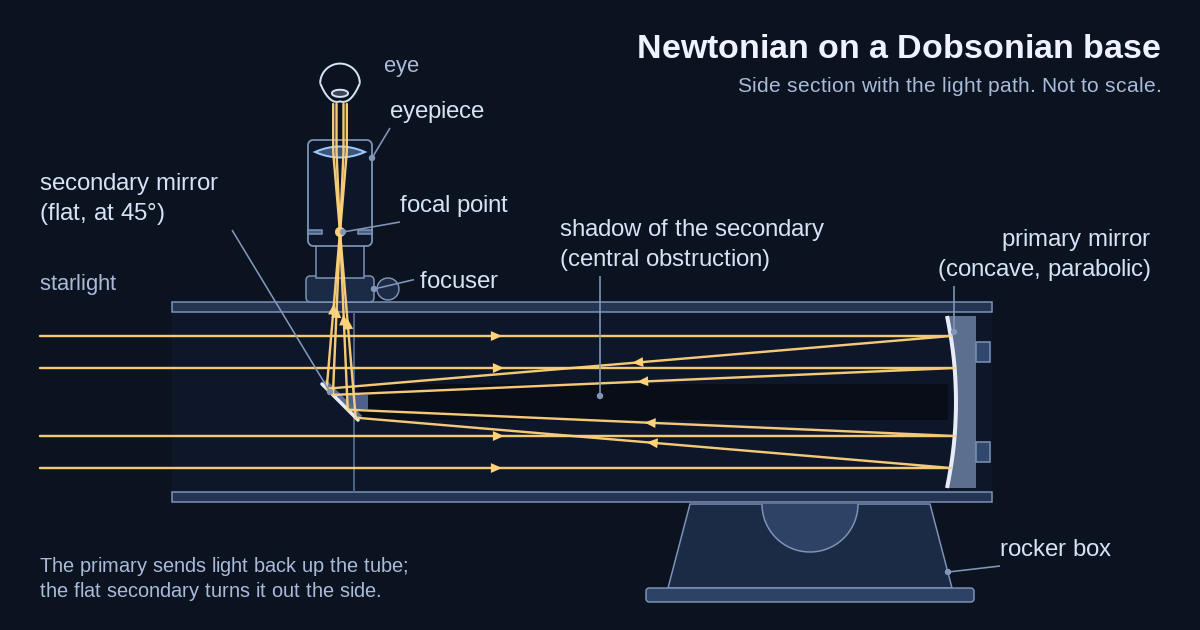
A primary mirror at the bottom reflects light to a secondary near the front, then out the side to an eyepiece. A Dobsonian mount is a sturdy alt-az rocker box. An 8-inch class Dob is the usual visual beginner type when you can store and move the tube and base. Tabletop Dobsonians in the 114-130 mm class fit tighter budgets when you have a table or stool.
Best for
Deep sky and general observing when you have yard space and storage. Try the chooser with a matching preset or open the simulator for this aperture class.
What each aperture shows
A 130 mm f/5 tabletop Newtonian with a 25 mm Plossl runs about 26x with a 5 mm exit pupil. Dawes limit is about 0.89". An 8-inch (203 mm) f/6 Dobsonian at 25 mm is about 48x with a 4.2 mm exit pupil; Dawes is about 0.57". Teaching limiting magnitude under dark skies is about 12.2 for 130 mm and about 13.2 for 8 inches. The same 8-inch scope at 10 mm reaches 120x for planets.
Typical size, weight and setup
A tabletop 130 mm tube sits on a stool or picnic table and stores in a closet. An 8-inch floor Dobsonian needs room for a long tube and a rocker box; plan on carrying both pieces to the yard. A 10-inch class gathers more light but the base is heavy for nightly carry.
Strengths
- Most aperture per dollar for visual astronomy
- Simple, sturdy mount that beginners can push to track
- Excellent for star clusters, nebulae, and galaxies under decent skies
Limits
- Tube plus rocker box needs storage and some lifting
- Open tube can collect dust; collimation matters (lining up the mirrors so stars focus to a point)
- Not the best grab-and-go travel scope
Collimation means lining up the mirrors so stars focus to a point. See the collimation guide.
Who should skip it
Skip a floor Dobsonian if you live in an upstairs apartment with no storage for the tube and base, or if you must fly with the scope. Skip frail-tripod "Newtonian" department-store packages that advertise 500x; those are not the same as a tabletop Dobsonian on a steady base.
Accessories you will want
- A low-power eyepiece for clusters and nebulae
- A shorter eyepiece or Barlow for the Moon and planets
- A finder (red-dot or optical)
- A simple collimation tool once you learn the screws
Questions
What is an 8 inch Dobsonian good for?
It is the usual beginner deep-sky aperture when you can store the tube and base: clusters, bright nebulae, galaxies under decent skies, plus strong Moon and planet views.
Is a Dobsonian a reflector telescope?
Yes. A Dobsonian is a Newtonian reflector on a rocker-box alt-az mount.
Do I need to collimate it?
Yes, from time to time. Collimation means lining up the mirrors so stars focus to a point. See the collimation guide.
Calculator · What you can see · All types
Sources
- Sky & Telescope, How to Choose Your First Telescope (retrieved 2026-11-24)
- Sky & Telescope, Hobby Killers: What Telescopes Not to Buy (retrieved 2026-11-24)
- Sky-Watcher USA, Classic 200P Dobsonian (Newtonian on a rocker box) (retrieved 2026-11-24)
- Tele Vue, Telescope Formulas / Common Telescope Myths (retrieved 2026-11-24)