Home / Tools / Magnification and FOV
Magnification, exit pupil, and FOV
Enter aperture, focal length, and eyepiece data. The same module powers the view simulator.
Bortle is a 1-9 sky-brightness class (1 darkest, 9 inner city). Seeing is atmospheric blur in arcseconds; 1-2" is typical on many nights. Field stop is the eyepiece's clear aperture at the focus; find it on the maker's spec sheet when you want the preferred true-field formula.
Formulas in plain language
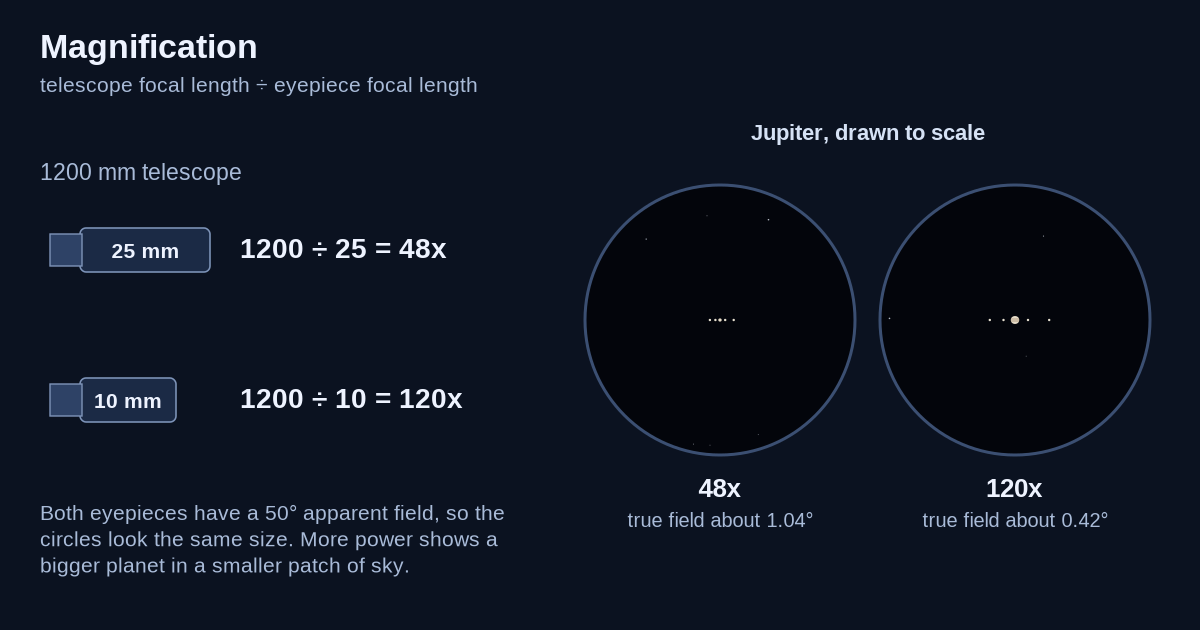
- Magnification: M = F_tel / F_eyepiece (times Barlow factor if present)
- Focal ratio: f/ = F_tel / D
- Exit pupil: d_ep = D / M = F_eyepiece / (f/)
- True FOV (approximate): TFOV ≈ AFOV / M Standard approximation; Tele Vue and others note distortion error often up to about 10%.
- True FOV (field stop): TFOV = (d_field_stop / F_tel) × 57.3° Preferred when a field-stop diameter is known.
- Dawes resolution: 116 / D_mm arcseconds (or 4.56 / D_inches)
- Rayleigh resolution: θ = 1.22 λ / D; at λ = 550 nm, about 138 / D_mm arcseconds
- Max useful magnification: Teaching ceiling about 2x per mm of aperture (about 50x per inch), the same as a 0.5 mm exit pupil. Seeing rule used here: power stops paying once the seeing blur is magnified to about 5 arcminutes, so M_max is about 300 / seeing in arcseconds (1.5" seeing gives 200x, 3" gives 100x), never above 300x. The seeing rule is a teaching rule of thumb chosen to match common experience (on most nights seeing limits useful power to roughly 150-250x), not a published formula.
- Light grasp vs the eye: Area ratio (D / d_eye)^2; magnitude gain 5 log10(D / d_eye). Assumed eye pupil stated on the page (about 6-7 mm when young and dark-adapted).
- Limiting magnitude (teaching): m ≈ 2.7 + 5 log10(D_mm). Rough dark-sky ceiling only; ignores magnification, sky brightness, and observer.
- Limiting magnitude (sky and power aware): Teaching simplification of Schaefer (1990): the eyepiece background is dimmed by (exit pupil / eye pupil)^2 and the optics throughput, the naked-eye limit is read at that background with NELM = 7.93 - 5 log10(10^(4.316 - B/5) + 1), then the light gain 5 log10(D_used / eye pupil) + 2.5 log10(throughput) is added. D_used is capped at eye pupil x M, so oversized exit pupils waste aperture. Schaefer's seeing penalty applies once M x seeing exceeds 900 arcseconds. Not modeled: atmospheric extinction (target assumed near the zenith), observer experience (practiced observers often go 0.5-1 mag fainter), and binocular summation. Throughput assumes about 85-90% for lenses and 80% for two mirrors, times (1 - obstruction^2).
Related guides: magnification, eyepieces, Barlow lenses, focal ratio.
Sources
- Tele Vue, Telescope Formulas / Common Telescope Myths (retrieved 2026-11-24)
- Tele Vue, Choosing Eyepieces (Basic) (retrieved 2026-11-24)
- Tele Vue, Choosing Your Telescope's Magnification (Al Nagler, S&T May 1991) (retrieved 2026-11-24)
- BBC Sky at Night Magazine, Understanding the limits of your telescope (retrieved 2026-11-24)
- telescope-optics.net magnification notes (Suiter / related discussion) (retrieved 2026-11-24)
- Bradley E. Schaefer, Telescopic Limiting Magnitudes, PASP 102 (1990): 212-229 (retrieved 2026-11-24)
- NASA NTRS 19900039111 (retrieved 2026-11-24)
- Unihedron / K. Fisher, NELM and sky brightness conversions (after Schaefer 1990 and Clark 1990) (retrieved 2026-11-24)
- John E. Bortle, Gauging Light Pollution: The Bortle Dark-Sky Scale, Sky & Telescope, February 2001, 126-128 (retrieved 2026-11-24)
- Bortle scale table with approximate SQM ranges (Wikipedia, citing Dark Skies Awareness) (retrieved 2026-11-24)
- Roger N. Clark, Visual Astronomy of the Deep Sky, Appendix E (surface brightness) (retrieved 2026-11-24)
- H. Richard Blackwell, Contrast Thresholds of the Human Eye, JOSA 36 (1946): 624-643 (retrieved 2026-11-24)
- Andrew Crumey, Human Contrast Threshold and Astronomical Visibility, MNRAS 442 (2014): 2600-2619 (retrieved 2026-11-24)
- telescope-optics.net, central obstruction effects (retrieved 2026-11-24)
- BBC Sky at Night Magazine, Why does my telescope show everything upside down? (retrieved 2026-11-24)
- British Astronomical Association, Getting started with your telescope: which way is up? (retrieved 2026-11-24)